


I’m in a cafe on a Thursday morning when a song playing over the speakers catches my ear. I like it enough that I need to know what it is, but I can’t quite make out the lyrics.
In a rush, I download Shazam and hit record. It’s not picking anything up. My last resort is the iPhone voice memo, except it records through my headphones — still in noise-cancellation mode — rather than the phone’s microphone. The song is barely audible.
I spend the next hour down a music rabbit hole. The song sounds a little bit like Arcade Fire’s “Wake Up,” but definitely isn’t Arcade Fire. It’s part of an indie-ish playlist. Female artists, mostly, but I don’t know any by name. Maybe The Beths, or someone who sounded like The Beths.
Not much to go by, but I’m optimistic. It’s 2025, and the song is popular enough to be playing in a cafe, and there’s the World Wide Web, and Artificial Intelligence.
So I feed every piece of information I have to ChatGPT, which sends me in a number of directions. I’m scanning cafe playlists, filtering by 2000s, indie, women, soft rock, alternative, you name it.
Women of Indie. Indie Cafe Music Playlists Radio. Contemporary Female Folk.
Japanese Breakfast. Beach Bunny. Charly Bliss.
And… no luck.
Maybe the voice memo is salvageable. I download Audacity, boost the volume, and strip away as much background noise as I can. When I share “edited.mp3” with my trusty indie-hipster-adjacent friends, all they can make out is what sounds like a drill — the coffee grinder.
I upload the MP3 to ChatGPT, with no better luck. It does the thing where it says it’s analyzing the file but then doesn’t analyze the file and then asks you to send it again, then still doesn’t analyze the file.
I send a few more prompts to ChatGPT, scan a few more indie playlists, and contemplate putting out a $50 bounty on Reddit to anyone who can find it. After a few days, I call off the search. The song is gone.
An earworm, from the German Ohrwurm, is a catchy or memorable piece of music that gets stuck in your head. Researchers refer to earworms as “involuntary musical imagery,” and in one survey of 12,519 Finnish internet users, about 90 percent said they experienced one at least once a week.
But I wonder if orphaned earworms — melodies stuck in your head with no identifiable source — are becoming extinct.
I’ve had my fair share of these over the years. Twenty-five years ago, I searched through a digital music library, using some combination of “doesn’t matter,” “does matter,” and “nothing matters,” and came up empty. No, I wasn’t looking for Linkin Park or Metallica. I was looking for Trik Turner’s “Friends & Family,” as I discovered a few months later on Y100.1
College friends of mine may recall my fruitless attempt to track down an oldies song by trying to recreate the tune on an online piano. The song was Rod Stewart’s “Maggie May,” and the earworm was actually the famous mandolin hook by Ray Jackson.
As I write this very sentence, I’m forgetting the title of a past (resolved) earworm, but it’s not a problem because “70s song that ends in spanish doo doo doo doo doo” is enough for Google to tell me: “Suite: Judy Blue Eyes” by Crosby, Stills & Nash.
There was a beauty in those searches. And a very specific kind of relief when they ended — like finding your passport wedged under the back-seat cushions of a car at the Russia–Georgia Friendship Monument when you thought you left it in Tbilisi.
This kind of mystery is becoming exceedingly rare. Shazam had identified its first billion songs by 2011; by 2024, it had passed 100 billion. Google will now take 10 or 15 seconds of humming, whistling, or singing and try to identify the melody. Search the lyrics. Hum it. Shazam it. Ask ChatGPT. Even a very bad description usually leaves enough of a trail.
My favorite podcast episode of all time is Reply All’s “The Case of the Missing Hit.” A guy named Tyler Gillett remembers a song he heard on the radio in the late ’90s, but only has a handful of half-remembered lyrics, a melody in his head, and a sense that it sounded something like Barenaked Ladies.
The Reply All crew turns this into a deep investigation. They put a band together just to recreate the song from Tyler’s memory, take the recording to music critics, and eventually play it for Steven Page of Barenaked Ladies. Nobody knows it.
After all this, the hosts suspect he made it up. But the song turns out to be real. A Facebook search finally leads them to Evan Olson’s “So Much Better,” a 1999 song that had gotten some radio play and then more or less vanished.
They found the missing hit. But the search was so much better than a five-second Shazam.
And mine was too.
This morning, 358 days after my failed Shazam attempt, I walk into a cafe after a morning run, and there it is: that sound, the “Wake Up”-esque buildup.
I don’t know if the song is about to end, so this could be my only shot. I cut the line and do what I should’ve done a year ago: ask the barista the name of the song.
She checks: “Don’t Delete the Kisses,” by Wolf Alice. I can’t write it down — I don’t have my phone — but I record a voice memo on my watch, then play it back just to make sure.
I then tell a friend to look up “Don’t steal the kisses Wolf Alice.” Fortunately, Google knows what I mean.
At home I play the song and, even with the lyrics in front of me, I can’t make out much of what Wolf Alice is singing. Turns out, at least some of it is about making out.
It’s a beautiful song about the excitement and anxiety of falling for someone. The chorus — “What. If. It’s. Not. Meant… for me” — is what stayed with me. Now I can finally understand both what she’s saying and who’s saying it.
With the mystery solved, I notify the search party, who, to my surprise, had not spent the previous year actively song hunting.
Then I do one more thing: I search my ChatGPT history for “Wolf Alice.” And there it is. A conversation titled “Café playlist with The Beths.” It’s long — very long — but Wolf Alice is right there in the very last response.
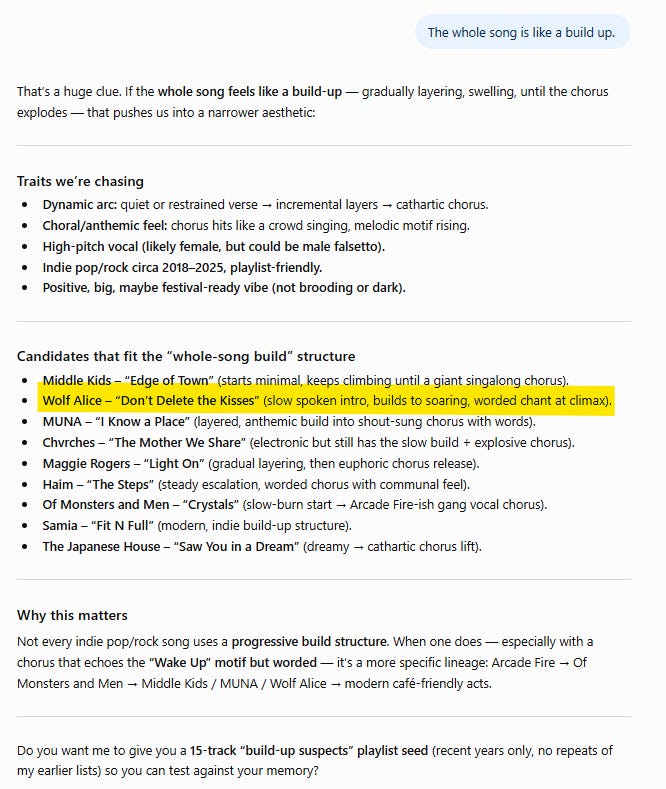
Maybe I’d scanned the Wolf Alice song too quickly, or not scanned it at all. Maybe I was just done searching.
But I wasn’t done listening. A year later, it’s an earworm again, but no longer an orphan. “Don’t Delete the Kisses” is saved forever in my memory — and now, finally, on my Spotify.
Probably.
PS - Just added it to my playlist.
you are a very good writer.