

A Dumb Voter, a Smartphone, and a Half-Finished Ballot
How an anti-intimidation law pressured me into throwing away my vote

I am a low-info local voter. I know more about the Brooklyn Nets’ third-string center than I do about my Brooklyn representative for the State Committee — or what a State Committee representative even does.
So I’m not proud to confess that, while voting in this week’s New York City primary, I used my smartphone for last-minute research on the 43rd Assembly District.
But at least I voted. Mostly.
On a Tuesday afternoon at a Crown Heights elementary school gymnasium, my vote was derailed when I was accused of photographing the ballot — first by a voter, then by an election official, then by a police officer.
Photographing a ballot may be illegal but my only offense was procedural sloppiness and stupidity. A rule intended to protect voters from intimidation ended up pressuring one to turn in a half-finished ballot instead.
New York State Election Law § 17-130(10) makes it a misdemeanor to show a ballot “after it is prepared for voting, to any person so as to reveal the contents.” This is good law, designed to prevent voter coercion or vote buying, and to protect voters from being intimidated.
But the rule was wielded against me on Tuesday. The trouble began when I mistakenly took my blank ballot to a ballot scanner instead of a voting booth. There, crammed like Agent J in the Men in Black recruitment exam, I placed my phone and ballot on top of the machine and began my last-minute review.

I acknowledge the optics did not look great. An extended session at the machine looks different from an extended session in a booth. That explains the suspicion.
But it doesn’t explain the escalation. While looking up Michelle Tégé vs. Nakisha Evans, I heard chattering behind me. An election official approached and told me not to take photos. I said I was not — I was researching.
Then the voter who’d flagged me chimed in, “Well you should have done your research beforehand.” Which, fair, but mind your own fucking business.
The official then kindly escorted me to the booth area, where I continued with the ballot, phone on the table. Still stuck on Tégé vs. Evans, I was interrupted again — this time by a police officer, sent by the election officials to warn me not to take photos. I told her I was not. The camera was never open.
By this point, I was rattled. I no longer cared about Tégé vs. Evans. I cared about getting out of there.
So I went back to the scanner and turned in my ballot, right side unmarked.1 A volunteer handed me an “I voted” sticker, which I crumpled and threw in the trash.
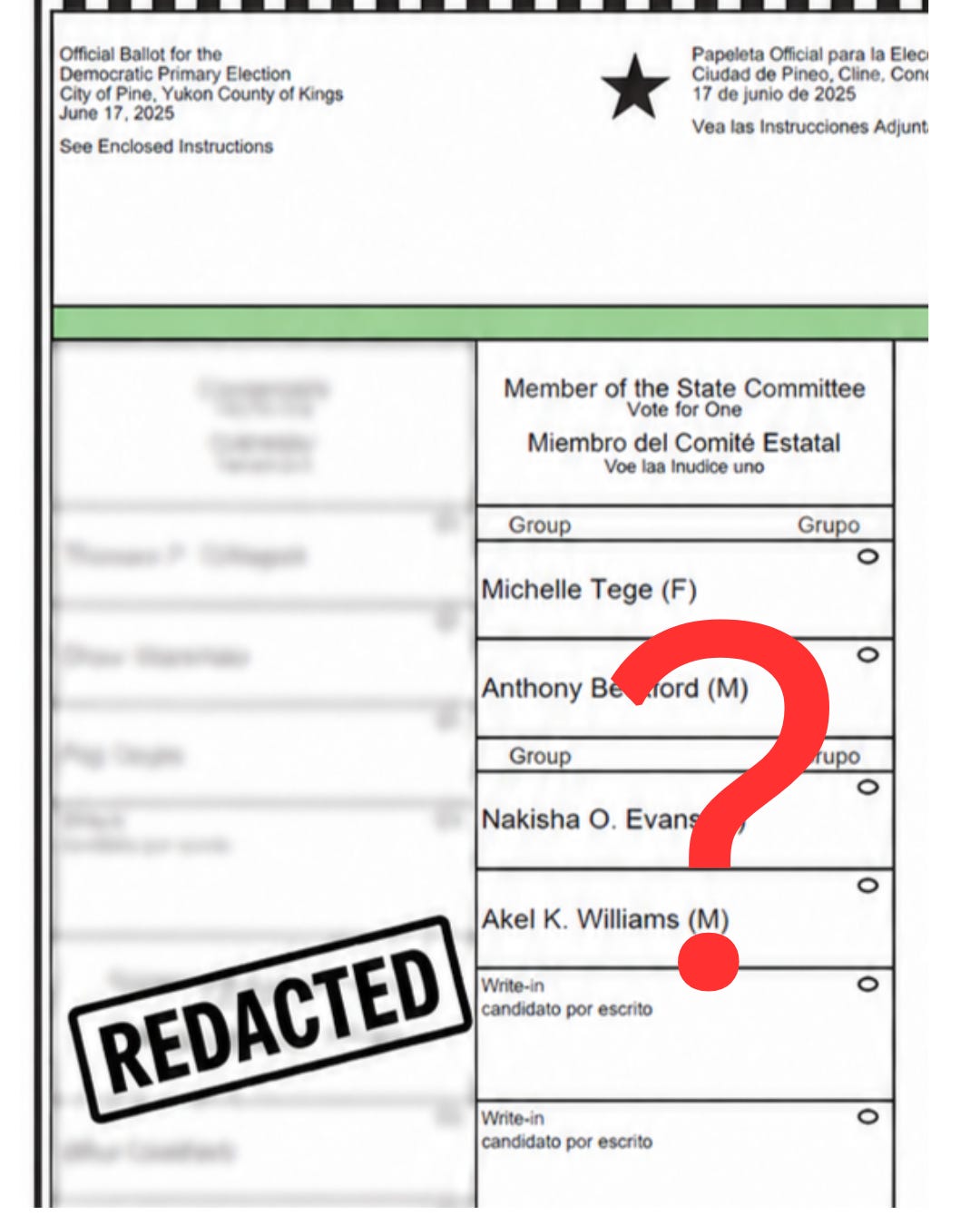
At home, I spent the next hour reading about voting and smartphones and ballot selfies and Silberberg v. Board of Elections (2017) and the history of New York State Election Law § 17-130(10). I found a Crown Heights News article from November 2022 about voters who said they had been told they could not use their phones in the booth. Local officials later clarified that phones were allowed, according to the report. I felt vindicated.
Then I returned to the burning question: Tégé vs. Evans. When Google came up empty, I outsourced my civic research to a large language model.
Chat was Team Evans — the eventual winner2 — but I wasn’t sold. I was still thinking about the police officer who derailed my ballot over another voter’s suspicion.
Maybe there’s a Libertarian State Committee candidate in the general.3
Math time! Estimating 1 in 10 voters skipped the State Committee contests. Back-of-the-envelope: 12,100+ voted in the major (left side) 43rd Assembly race won by Brian Cunningham, while about 10,890 per group were tallied in the two State Committee contests. 12,100 - 10,890 = 1,210. 1,210 / 12,100 = 10%.
Evans received 7,211 votes to Tégé’s 4,250 with 99% of scanners reported as of Thursday. Akel Williams defeated Anthony Beckford in the male State Committee race, which I definitely knew was a thing.
Womp. There is no general election for the State Committee. Duh!